Jack Dragna
Born – Corleone, Sicily, April 18, 1891
Died – Hollywood, CA, February 23, 1956
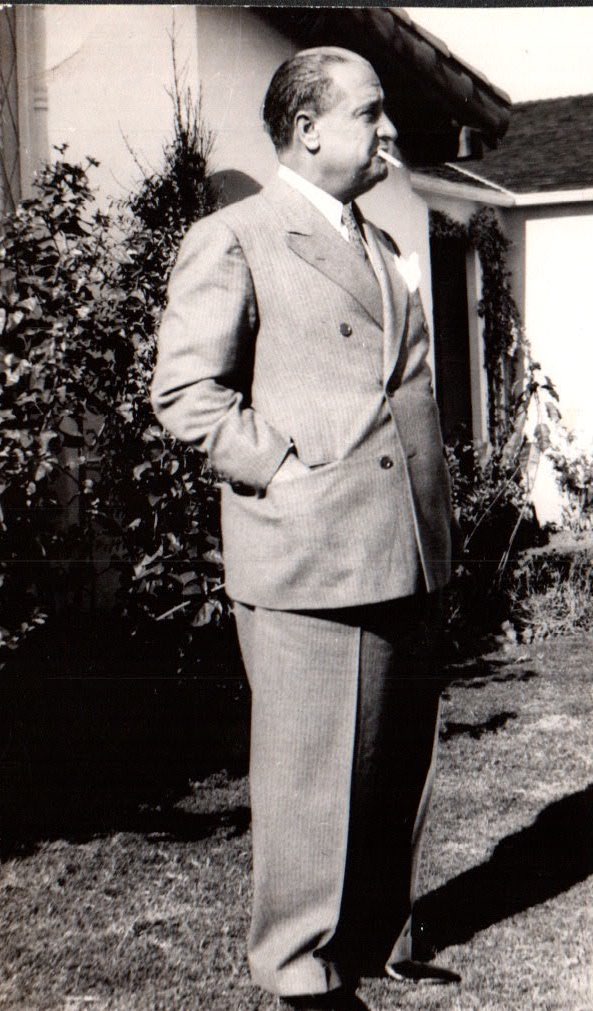
CLICK Image for J. Michael’s Las Vegas Mob Museum Dragna Bio
Image introduced to the world in The Los Angeles Sugar Ring by Dragna Grandson-Biographer J. Michael Niotta
Jack Dragna was an early influential figure who rose to prominence in Los Angeles through bootlegging, political, and gambling endeavors. Prior to the coming of the 18th Amendment, he engaged in black hand tactics such as extortion. Early in Prohibition, he and other key figures put an end to the long ongoing vendetta between LA’s warring Sicilian clans, solidifying power under a single banner, a Mafia organization known as the Los Angeles Brugad. Leadership of this group went from Vito Di Giorgio to Rosario DeSimone to Joe Ardizzone then (by force) to Jack Dragna. Heading up the “Organization” out West for a quarter century—from 1931 until his death of natural causes in February of 1956—Dragna served as their most powerful leader.
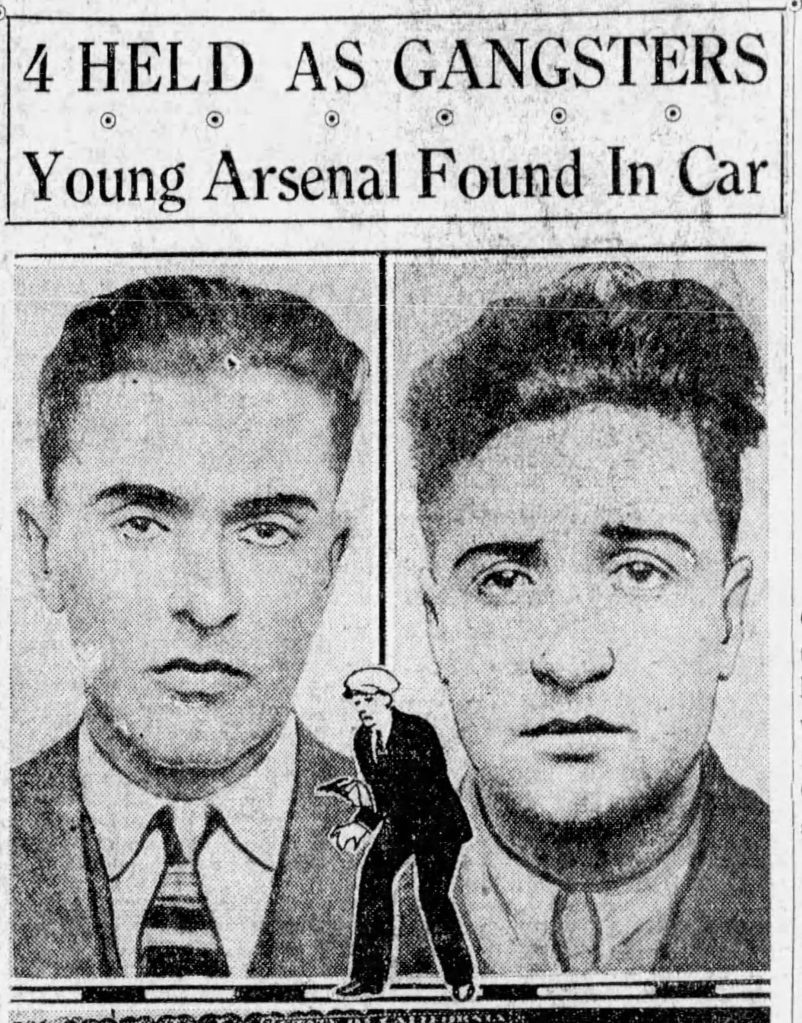
Johnny Roselli & Jack Dragna mugshots, 1930. Their first (known) but not last joint arrest
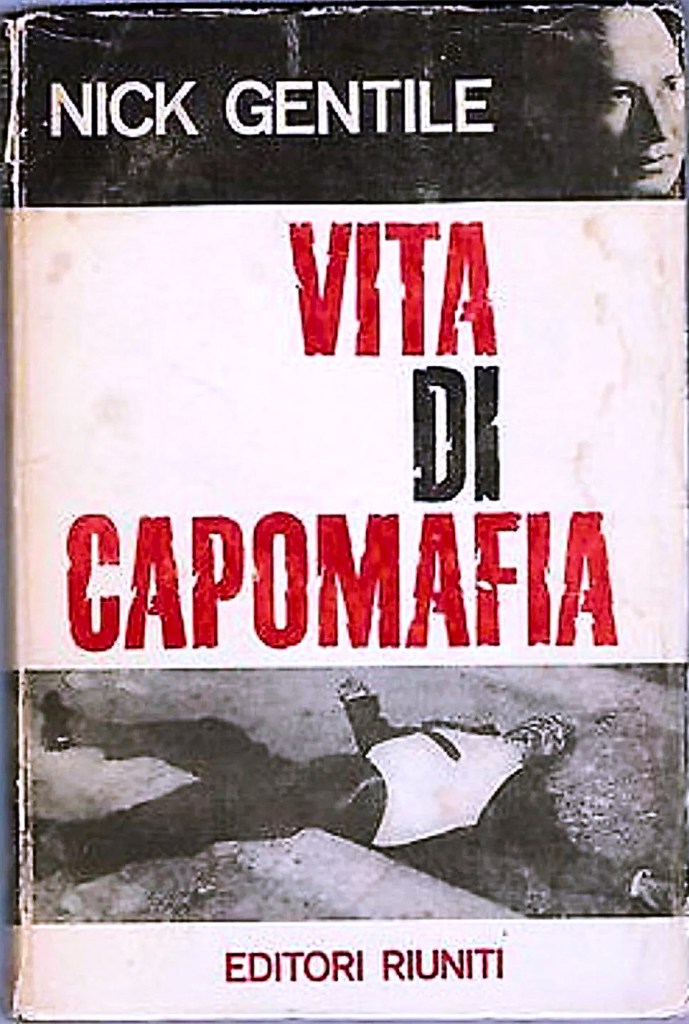
Although sources Allege the West Coast was too insignificant to be included in the formation of the New York Commission or to even attend meetings, federal files and the accounts of Informants and high-ranking cosa nostra member, Nicola Gentile, refute such claims. In his memoir, Vita Di Capomafia (1963), Gentile divulged “The first to go to the restaurant, which had been chosen by [Salvatore] Maranzano, were the representatives of California and the far West, ten in all” (translated from Italian). Not only did they have the greatest distance to travel, they were the first to arrive.
During the violent Castellemmarese War of the early 1930’s, it appears L.A. boss Joe Ardizzone sided with Salvatore Maranzano against Giuseppe “the Boss” Masseria. Dragna–a native of corleone, sicily who grew up in East Harlem–had allies on both sides of the fence and may have stayed cautiously neutral. With dissension brewing in SoCal, Ardizzone Conceded to step down–Give Up leadership in exchange for his life. It was a promise that was not kept. The former don disappeared for good a short while later.
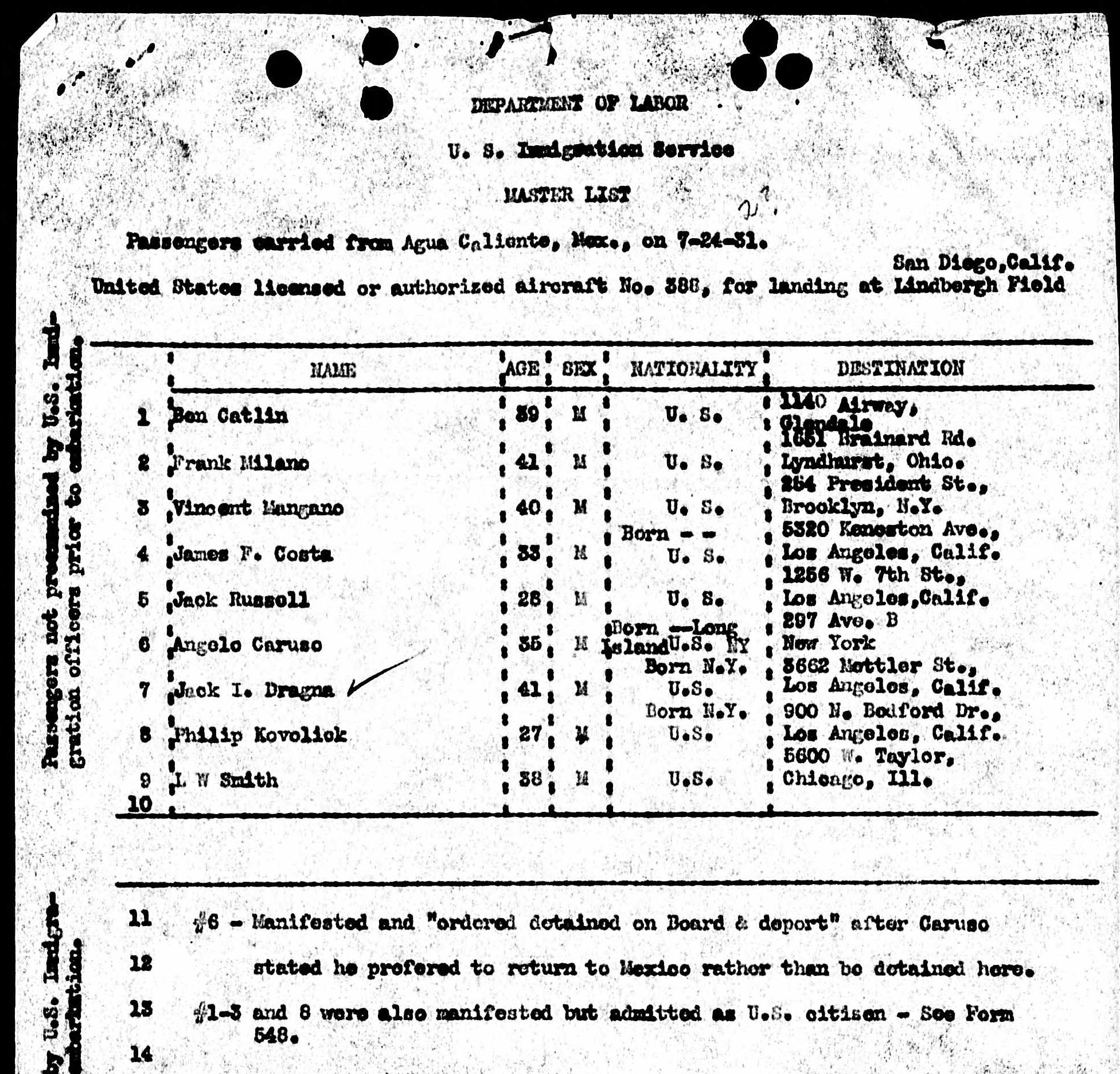
Informants reveal Jack Dragna attended higher echelon meetings back East during the thirties and on, and official travel documents show that he entertained distinguished guests from all over the country by as early as the summer of 1932. An airline manifest for a return flight from Agua Caliente, Mexico to San Diego, California lists the following passengers: Jack Dragna and his local associates Jimmy Costa and Jack Russell (an alias for Johnny Roselli); Cleveland Boss Frank Milano; New York Boss Vincent Mangano; Salvatore Maranzano’s former under boss, Angelo Caruso, who attended to represent new boss Joe Bonanno; a New York based associate of Meyer Lansky and Ben Siegel, named Phil Kovelick; and at least one other potential big player traveling under an assumed name—L. W. Smith of Chicago.
Although pop culture outlets are quick to spout that Jack Dragna never got a foothold in Las Vegas, in a way he actually contributed to the formation of Sin City. Dragna and his organization were largely responsible for purging the founding fathers of modern day Las Vegas from their earlier stomping ground of Los Angeles. Spring Street Combination members Guy McAfee, Tutor Scherer, Milton “Farmer” Page, Chuck Addison, and others were all well-established L.A. gamblers and racketeers decades before moving into Southern Nevada. Throughout the Roaring Twenties, they ran the city’s vice operations out of City Hall via puppet Mayor George Cryer.
The Italians had long been a stone in the shoe of the Combination’s bootlegging enterprises but became a greater threat once Joe Ardizzone and Jack Dragna entered politics in the mid-20s by forming the Italo-American Welfare League. And after Dragna took over the L.A. Brugad in 1931, matters got far worse for McAfee and his criminal associates. Through all-out warfare Jack and Tom Dragna carved a piece of Los Angeles for the Italians. According to an informant, the Dragna brothers proved “ambitious,” “domineering,” and “utterly ruthless.”
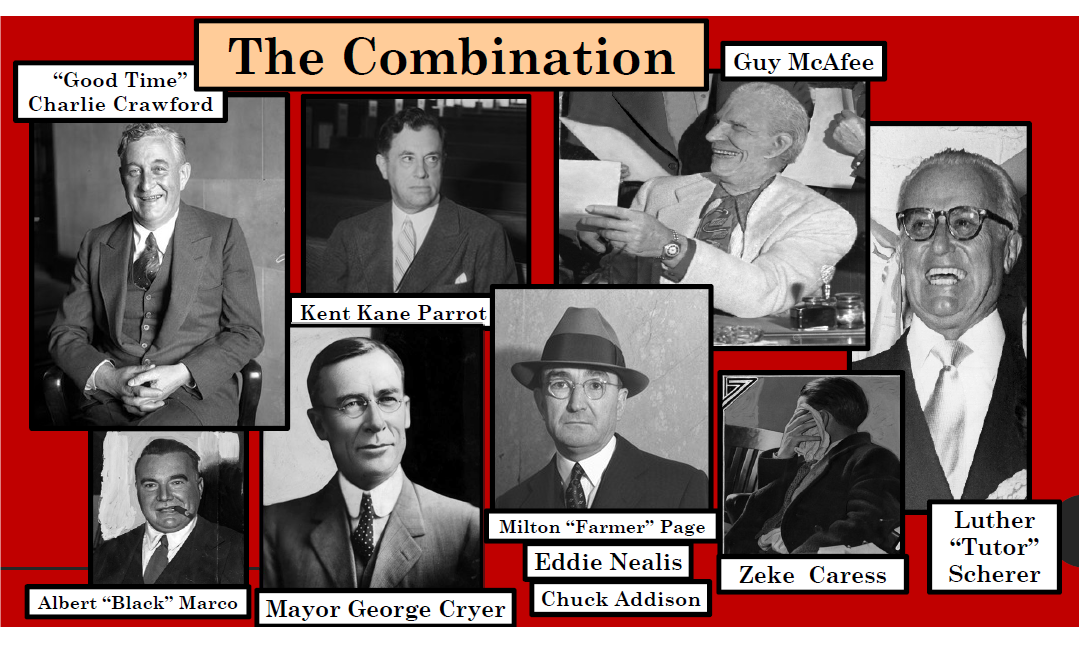
The Spring Street Combination (Los Angeles), taken from Niotta’s Las Vegas Mob Museum lecture, Southland Syndicates – NOTE: that is Not Zeke Caress.
Under this new leadership, the Organization muscled into the area’s gambling rackets. And it wasn’t long before they “were cut in.” The Combination continued to operate in L.A. during the remainder of the depression-ridden thirties, predominately in gambling and prostitution, but they now paid a tithe to the Italians as a cost of doing business.
If the local mafia hadn’t entered politics or cut into the Combination’s gambling rackets, Guy McAfee and his associates probably would have stayed in the City of Angels. And if they had, who knows what Las Vegas would be like today. But the Italians can’t take all the credit. Several other driving forces helped motivate their California departure. This included the crusading efforts of new mayor Fletcher Bowron, the overzealous antics of Governor Earl Warren, and the muscle of a newer arrival–syndicate man Benjamin Siegel landed in late 1936.
The Combination departed Los Angeles in 1938 and ’39 then quickly pioneered what is now referred to as the Fremont District in Downtown Las Vegas, having a hand in the Frontier Club, El Rancho, Pioneer Club, the Golden Nugget, and a variety of other projects. Guy McAfee is even credited with branding Las Vegas Boulevard, “the Strip,” naming it after Hollywood’s own Sunset Strip. Who would have ever thought the guys who couldn’t hack it in L.A. would make such a big splash in Southern Nevada?
Jack Dragna and Benjamin “Bugsy” Siegel are often portrayed as bitter enemies, with Dragna typically cast in a subservient role in old mob books and cinema. Some theories even stipulate the powers back East, big names like Lucky Luciano, delivered an ultimatum, personally telling Dragna to stay out of Siegel’s way. Although this makes for a very cinematic and noir twist, In reality Siegel didn’t leave new york to expand anyone’s interests. While his pals probably urged him to ditch the Big Apple, getting out was about survival! After Special Prosecutor Tom Dewey put Luciano Away on a trumped up charge of compulsory prostitution, Siegel became Dewey’s next target. It didn’t look like his alibi for a pair of murders would hold up so he headed west. his sister was already settled in Los Angeles and he’d made a habit of visiting. during earlier trips, he fell in love with hollywood, so relocating there made perfect sense. Coincidentally, it seems many of the SoCal organized crime figures came upon the scene for a similar reason (avoiding Arrest)–Jack Dragna included.
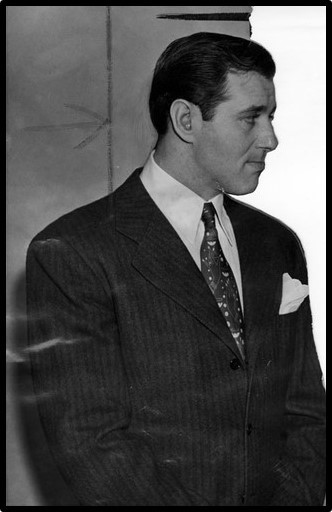
Benjamin Siegel
In The Last Testament of Bill Bonanno, son of Bonanno family Boss, Joe Bonanno, explained that “The truth is that it wasn’t the Commission who sent Bugsy Siegel to California. The Commission did not have the authority to make that decision.” Despite pop culture depictions, the Commission didn’t govern internal family business; it merely existed to keep peace among the various families. sending a Jew to invade a Sicilian’s territory would have had the opposite effect. The very idea of an incursion goes against the entire premise. besides, by now Jews and Italians were working together—which is exactly what came to pass in Los Angeles.
Fiction about the Commission and about Ben Siegel’s move to L.A. have been perpetuated by countless authors and crime journalists. The mythology surrounding “Bugsy” was certainly strengthened by Turkus and Feder’s 1951 bestseller, Murder Inc, which became a syndicated column shortly after Jack Dragna’s passing. While definitely insightful for its time, the true crime title did give birth to at least one inaccurate theme. Turkus mistakenly used the word “lieutenants” to describe Jack Dragna and Mickey Cohen. While many an author since has used this line to suggest the pair were on an even plane (and subordinate to Siegel), this was very far from the authors’ intent. In fact, the text indicates Dragna was Siegel’s “most valuable asset” on the Coast. And by their estimation, Mickey Cohen was nothing more than a mere “small shot” who went “for the sandwiches when the big-boys have their hotel room sessions.” Somewhere along the way, Hollywood and a bevy of crime writers managed to get the relationships Mixed up.
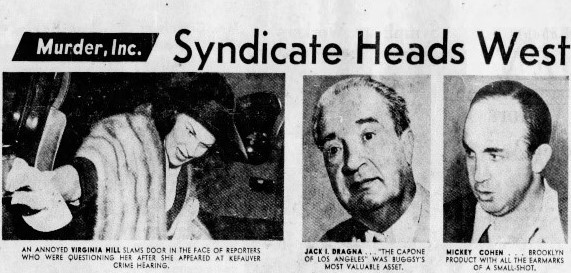
Excerpt from Burt Turkus and Sid Feder’s Murder Inc after portions were released as a syndicated column in 1958.
The misconception that Jack Dragna and Ben Siegel were rivals has largely been popularized by the Mickey Cohen autobiography, In My Own Words (1975). But Mickey had been lying to readers about his past since at least 1949–that’s the year he regurgitated an inflated version of his life story to reporters of the LA Daily. But as the feds have less-than-delicately noted in Mickey’s federal files, the ruse he sold reporters fails to align with the facts…and his arrest record. Agents portrayed Mickey as a “braggart” who—in order to bolster his “reputation as a tough”—often took credit for crimes he didn’t commit. This even included murder!
Despite Mickey Cohen’s contentions and what has since become popular belief, Jack Dragna and Ben Siegel worked together amicably. This partnership centered on the racing wire, an industry catering to the large number of bookmakers taking off-track bets all across america. Without a subscription to the wire, bookies could not operate effectively. Once Dragna and Siegel realized they couldn’t muscle a cut of the nation’s dominant provider (Continental), they collaborated with a variety of other syndicate and mafia members to establish a competing service. it was known as Trans-American (TA). Dragna and Siegel led the efforts out West, with each owning their own subsidiary of the parent company.

In California, Jack Dragna incorporated West Coast News and Globe Distribution, printing The Daily Sports Record–a scratch (pamphlet) nicknamed the Blue Sheet. In Las Vegas, Ben Siegel and Moe Sedway put together their own complimentary brand of TA, establishing the Golden Nugget News out of Guy McAfee’s new casino.
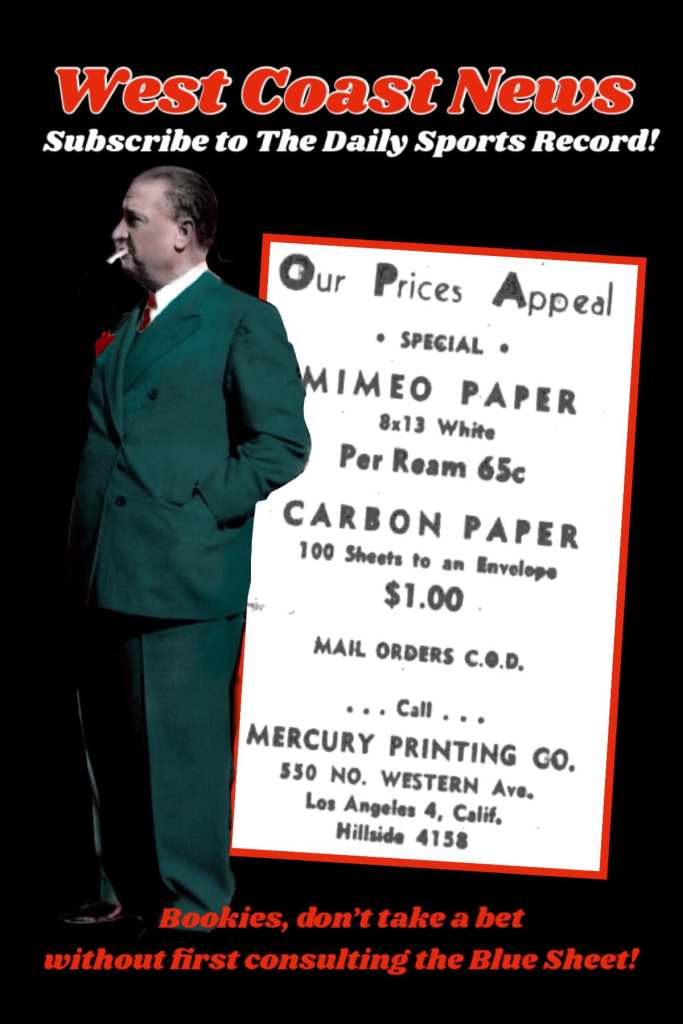
dealing directly with bookies, These Subsidiaries acted as a buffer protecting Trans-American. Each subsidiary received its track information from TA and provided a scratch sheet to subscribers. But Unlike Siegel’s operation, Dragna’s did far more–It also employed spotters to take in real time race results from the tracks throughout the region. this wasn’t necessary in Nevada, where gambling was legal and the ponies weren’t running. dragna’s spotters signaled results to nearby operatives watching with high powered telescopes. From there, the information went out over an actual wire via teletype, reaching tA’s hub in chicago to be further distributed to other subsidiaries.
Mickey Cohen’s role during this syndicated endeavor can easily be summed up. He was “the help.” Not only was Mickey far from an equal, or even a partner, his end of the set up wasn’t much more Involved than mere muscle. Cohen and individuals like Joe Sica, Allen Smiley, and Frank Bompensiero were tasked with conveying messages and persuading bookies to leave Continental for the new service. Despite this fact, in a vain attempt to boost his own worth and level of involvement, Mickey sold another story, screaming “rivalry!” And naturally, he posed himself as a much Bigger player in the mix. “Benny Siegel’s knocking over Continental was kind of a slap in the face to Dragna and [Johnny] Roselli who thought they were running the West Coast.” Contrary information came from Continental employee George Redston, who worked on the wire in Chicago and Los Angeles.
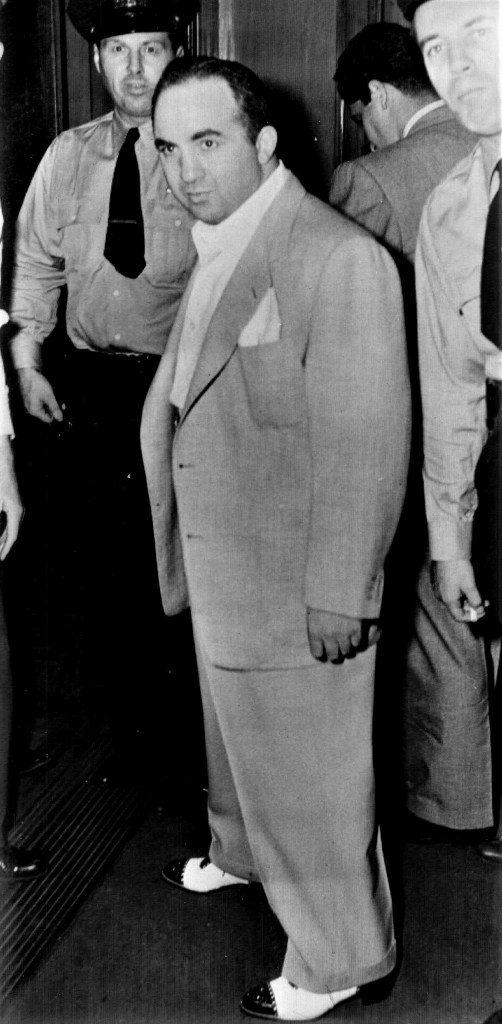
Under oath (and later in his book The Conspiracy of Death), Redston explained that Jack Dragna personally met with Continental Head Russell Brophy “and explained that he wanted Mickey Cohen and Joe Sica to distribute Continental’s racing sheets.” Redston also revealed that at a later juncture Dragna and Ben Siegel came in together to speak with Brophy about the matter. These and other pertinent details are conveniently left out of Mickey’s version. In truth, Jack Dragna was very well liked and respected By his peers locally and nationwide. the Siegel family were guests in the Dragna family home on multiple occasions. Even Mickey had to admit, “Dragna was very powerful and well respected.” he also conveyed a deep respect for Jack and his family.
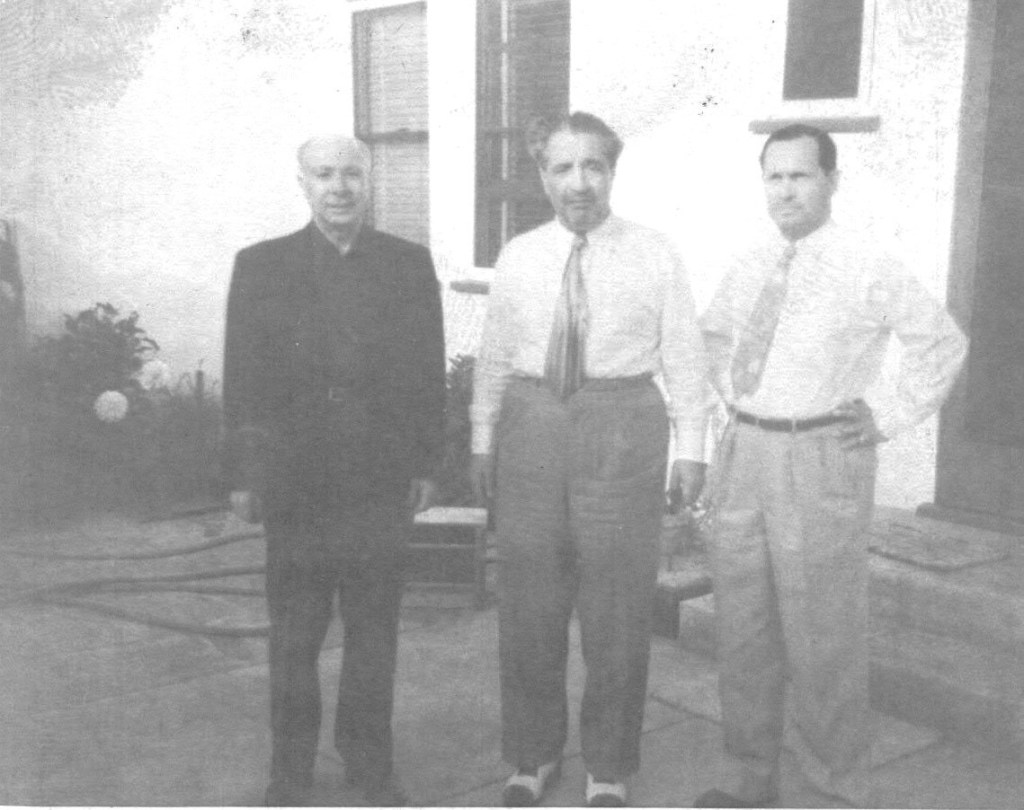
Stephano LaSalle, Jack Dragna, and Tommy Lucchese at Dragna’s home for the wedding of his daughter, 1948.
Following Ben Siegel’s murder in the summer of 1947, Mickey Cohen grew ambitious. but for many, the gambler’s loud and public antics were too much. a number of attempts on his life followed. Authors and journalists pitched it as a “war” for control of the city’s bookmakers, referring to it as “The Battle of the Sunset Strip.” Countering the description, enemies trade blows in battle . . . and in this instance, the bullets only flew in one direction. Although Mickey survived a number of assassination attempts, nearly everyone who ran with him was murdered or jumped ship for the Italians. In the end, not one “made man” received a single scratch. As It turns out, cash was the real motivation. With Mickey out of the way, the Italians stood to take in far more in protection money.
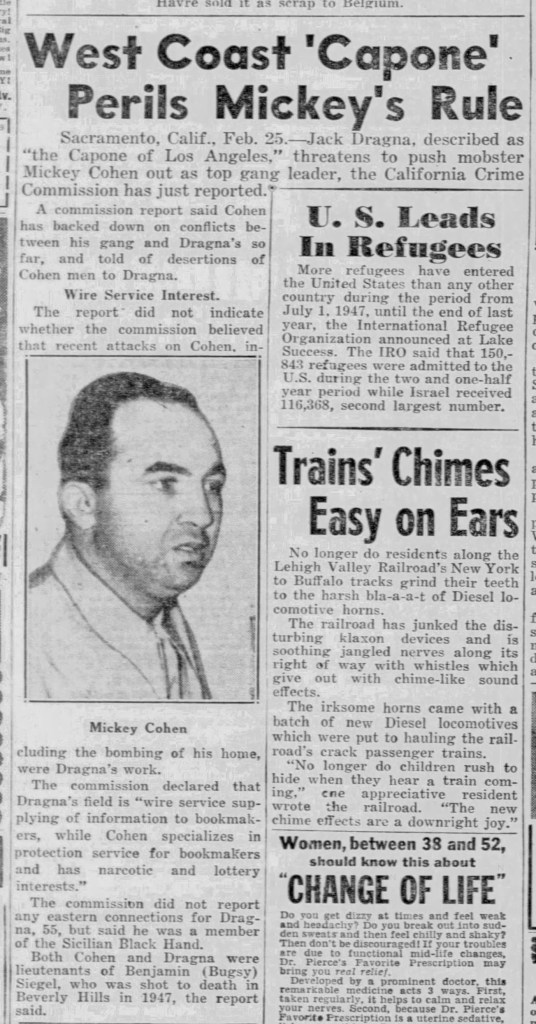
Mickey’s run of the rackets in Los Angeles was about Up anyway. After being convicted of tax evasion in the summer of 1951, he spent four years in prison. whatever bookmaking and union interests he held transferred to the italians. If you could call it a war, then Dragna certainly Won.
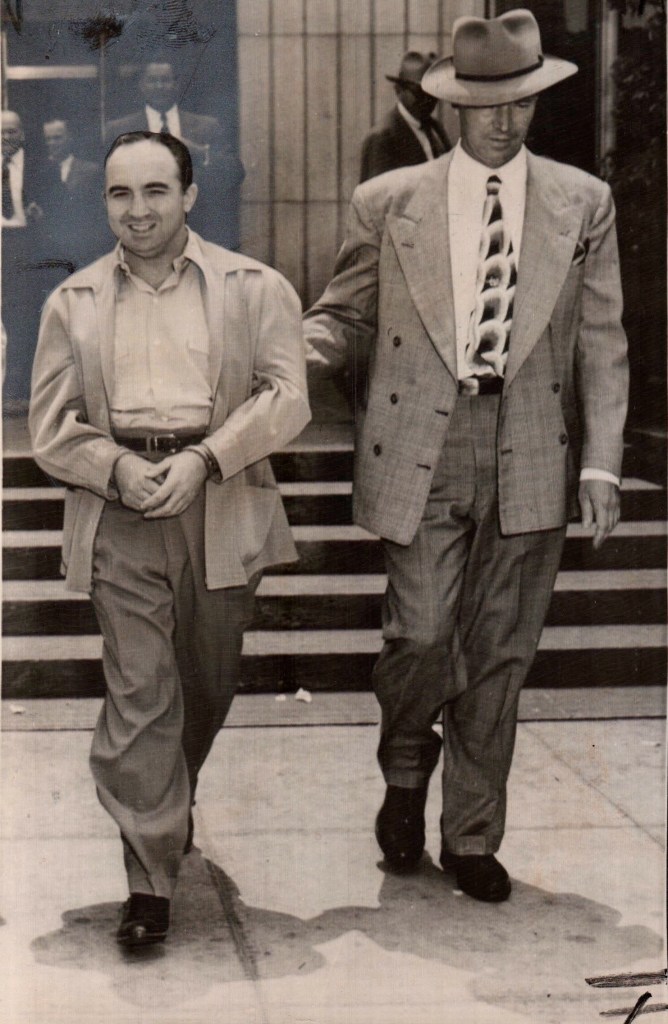
In 1950, Senator Estes Kefauver and his associates sought to spotlight the American gangster problem. During a series of proceedings held throughout the country (some of them even televised), Kefauver’s crime committee alleged that Continental Press head James Ragen, Sr. had this to say with his dying breath: “Jack Dragna is the Al Capone of Los Angeles!” The claim seems unlikely considering gunmen shot the racing wire mogul down in Chicago years earlier. True or not, the new handle stuck. the committee hung a few others on Dragna as well, calling him the “Mafia Boss” of the “Pacific Coast” and the “Kingpin of the Southern California Bookie Syndicate.” After that, Flying under the radar was no longer an option.
Losing his wife, Frances, to cancer in 1953, and his own failing health made life exceptionally difficult for Jack Dragna. His lifestyle and gambling operations suffered, hampered again and again by excessive deportation efforts and an aggressive campaign of harassment led by the follow on to the L.A. Gangster Squad–Captain Lynn White’s Intelligence Division. Obstacles such as this kept The Dragna brothers from getting better-established in Nevada. Although Jack and Tom owned various properties in and around Las Vegas, applied for a gaming license in the area, and even built a ranch on the outskirts of the city, continued rousts and an order restricting Jack to L.A. County, kept the plan to expand into Nevada from Ever seeing fruition. Despite the hurdles, the Dragnas did manage to put together a beneficial “juice” arrangement with the Sheriff’s Department. federal files also reveal the Dragnas received a regular piece of the action from casino operator Benny Binion, and a wire-tapped telephone conversation strongly suggests Jack and his associate Allen Smiley held an interest in the Desert Inn.
Jack Dragna succumbed to a heart attack on February 23, 1956, going quietly in bed while a guest at Hollywood’s Saharan Hotel. With the long time relationship back east now severed, an abrupt decline in the local mafia set in. none of the bosses that followed were able to keep things together. None of them commanded the respect of the other family Leaders either.
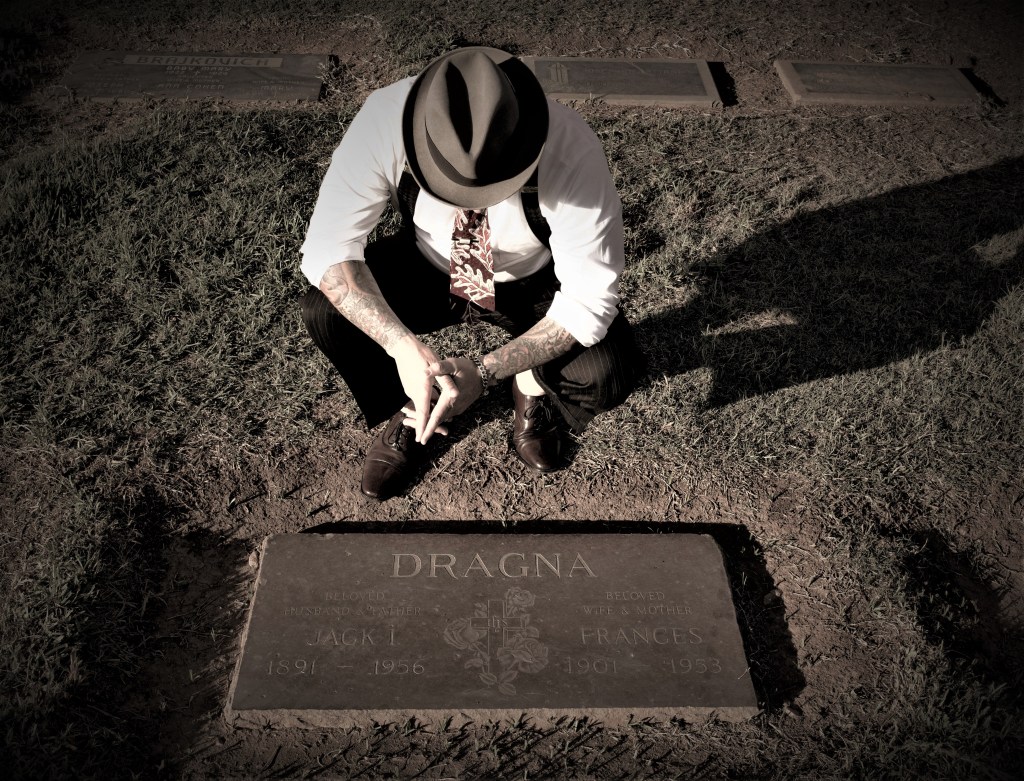
J. Michael visiting the grave of his great grandparents, Derby Classic Photo
As a result, a new and Negative legacy for the brugad sprouted. oddly, years later crime writers Began to cast this Weak and ineffectual reputation over the older regime. Rumor even started to spread that eastern gangsters looked down on Jack Dragna and his organization, referring to them as the “Mickey Mouse Mafia.” But the timeline doesn’t agree.
It was 1979 when midwest newsmen printed the “mickey mouse mafia” comment that chicago gangsters Mouthed about their west coast counterparts. investigators picked it up with a hidden listening device. Although the story saw print in ’79, the phrase didn’t gain much momentum until LAPD Chief Daryl Gates uttered it to the press in late 1984, following the wrap up of Operation Lightweight–a crackdown on the local mafia’s recent activities. But Gates wasn’t talking about the lineup Under Jack Dragna three decades earlier. He was referring to the Organization under its Current leadership. and as it turns out, Gates didn’t get the Term from Chicago Gangsters. Newspaper coverage Reveals that law enforcement in the city of angels had been using that phrase to describe the LA Mafia since at least February of 1974! Chances are, they were inspired by the mafia spoof “The Gang That Couldn’t Shoot Straight.” The film Hit Theaters in December of 1971. some of the advertisement posters used the Byline “The Mickey Mouse Mafia.” Ironically, the film starring a very young Robert De Niro pokes fun at New York Mafiosi instead of Los Angeles.
Around the same time Chief Gates’ words went “viral,” criminal families throughout the country felt a similar sting. Mafiosi everywhere were suffering at the hands of turncoats. Making matters even more difficult for criminals, law enforcement agencies had grown astute, learning Mafia tactics from informants. Naturally, newsmen took their swings. Journalists pointed out that “in Cleveland and Denver, where Mafia gangs once flourished, FBI officials say each city is left with a lone mobster who was made.” And they even labeled the Bruno-Scarfo group in Philly the Geritol Gang! Clearly California wasn’t the only ship sinking.

A Graphic Niotta created from newspaper clippings for his former NCS column, The early days of los angeles
Several other factors prove the “Mickey Mouse Mafia” Moniker never extended to the earlier days. firstly, the phrase didn’t even come into existence Until Sometime in the 1970s–a decade and a Half or More after Jack Dragna’s passing. This makes sense considering the term cannot be found in any of the early federal files. it isn’t used once in Mickey Cohen’s 1975 autobiography either. although Ovid Demaris didn’t include it in his 1980 best seller, The Last Mafioso, the central figure in this work is the true muse behind the phrase. Right when Officers were picking up wise crack remarks from chicago gangsters on hidden mikes, one of their own (Fratianno) was busy touring the country testifying against his fellow mafiosi. Even more difficult for the Boys From Chicago to swallow, Fratianno Was a former member of their organization.
Despite these truths, by the close of the 1980s, “Mickey Mouse” was being used excessively to refer to a Much earlier period of organized crime. writers began taking jabs at Jack Dragna too, calling him weak, inept, and the best of a poor lot. a couple years later a film Decided to roll with the Emerging theme. The highly fictional Flick Bugsy hit theaters in 1991, right when the world wide web went live. Things really snowballed after that. Equally damaging was the later flop, Gangster Squad (2013)–a farcical depiction of Los Angeles crime elevating Mickey Cohen to the status of king. Even more ridiculous, although Dragna died of natural causes, the director assassinates him on the big screen (along with his wife and two children). such Offerings have painted a Very backward view of the History of organized crime out west. it’s time to take a deeper look.
in 1987, smack in the middle of the media rise of the “Mickey Mouse Mafia” hype, the Los Angeles Times gave its own assessment of the city’s longest reigning leader: Jack Dragna Is “the only classic Godfather the city has ever known.”
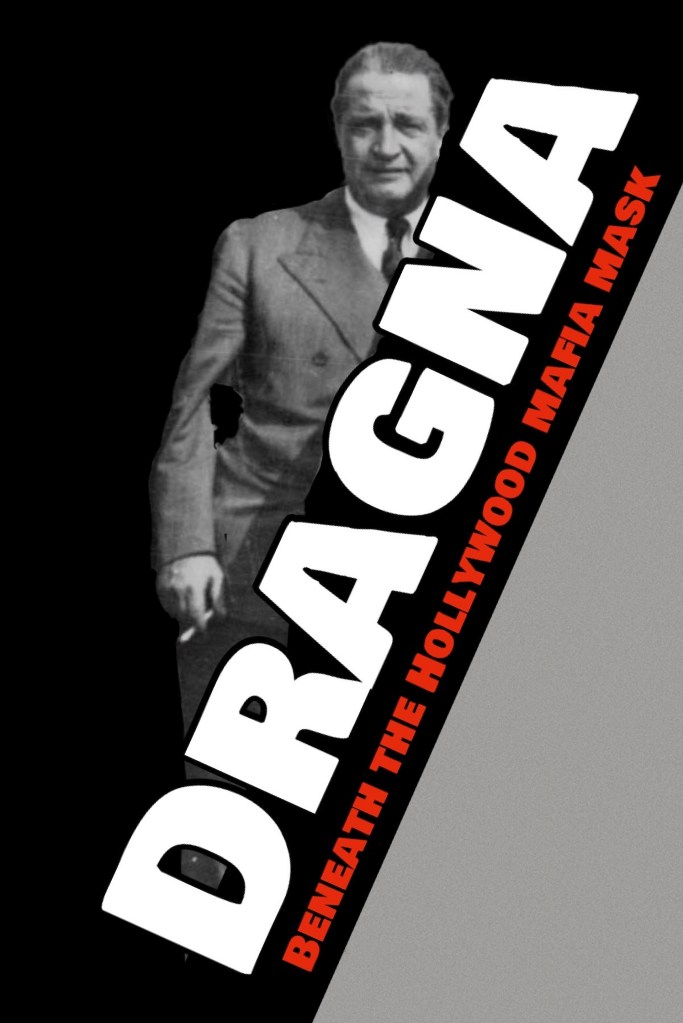
The Jack Dragna biography has been divided into three separate stand alone Biopics: Beneath the Hollywood Mafia Mask, The Business that Bound Them, and Jack Dragna’s Los Angeles.
Visit the Writing section for more details
 J. Michael Niotta PhD | Official Site